Visit Arwen’s blog to read my take on intra-office romance and sexual harassment. I happen to have firsthand knowledge of both! The harassment actually had a happier ending. Oof.
Category: Uncategorized
Sgt. Pepper Style
Today’s look brought to you almost entirely by Target.
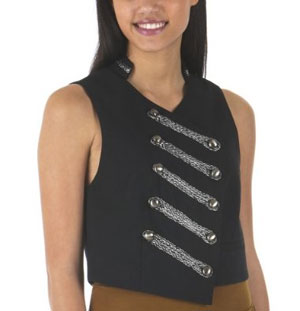 The actual vest, to the left, which I paid $35 for at Target, was part of the 2008 Go International collection. The model’s hair blends into the mandarin collar, and is hiding the embellishment there.
The best thing about this waistcoat is the fit. It is cut above the waist in the back, graduating to the navel at the front. That sort of cut accentuates or creates a waistline.
I usually wear it unbuttoned because I like the shape better, and paired with a long-sleeved, black v-neck from Isaac Mizrahi’s Target collection. Any old v-neck would do, this one just happens to be my favorite. I paid about $20 for this one.
The slightly flared trousers are from this season at Lane Bryant, and cost $29. The shoes are Target peep toes, and cost $20.
If you are practicing the art of dressing to the count of 9, this vest would be a 2.5. Since it is so highly embellished, I am keeping the accessories to a minimum. My main accessory is bright lipstick, but I am also wearing Granny’s understated diamond(?) studs, my wedding band, and a small watch.
On watches: I’m hard on watches, so I don’t buy expensive ones. I have found that the $12–$24 watches at WalMart are great for me. I can buy a variety of styles at those prices, which means I can change them out with different ensembles. It also means they last longer because I’m not beating the same one to death daily.
Philippa Gregory
Also written for The Dusty Shelf, this interview with Philippa Gregory came about prior to her book, The Other Boleyn Girl, becoming a movie. I am thrilled with the success she’s had.
Interview with Philippa Gregory
by Lane
My good friend Nicole often sends me books for gifts. Two years ago, she surprised me with a new historical fiction work called The Other Boleyn Girl, by Philippa Gregory. I’m not sure who to fault, friend or author, for the two nights I went without sleep but I could not put the book down. Philippa Gregory quickly became one of my favorite writers.
Among her wide bibliography, most recently Ms. Gregory has published The Queen’s Fool and The Virgin’s Lover. Each work is stunning in its detail and historical accuracy.
I was very excited to catch up with Ms. Gregory, who is currently at work on her next novel, a story of Katherine of Aragon. She was kind enough to spend some time answering questions for The Dusty Shelf.
TDS: You have written both contemporary and historical fiction. Do you find it more interesting or challenging to write a character from a brand new perspective, or to write a character from a set of preconceived notions based on historical documentation?
PG: I find it most interesting to write a character set in an historical period. The research is the structure for both the novel and the character and everything has to flow, logically, from the history. The development of both character and story have to explain and illustrate the facts.
TDS: What is the most difficult aspect of writing historical fiction? (Attention to detail? The 21st Century mindset? Finding a character?)
PG: I think the 21st century Mindset is the greatest obstacle to writing good historical fiction. You never fully know your own prejudices and misconceptions. One can be alert to the differences from one period to another, but your focus of interest itself is dictated by your own period of time. For instance, I cannot help giving a psychological explanation which is informed by Freud and those who have come after him. Someone in the Elizabethan period would think in terms of the unconscious and subconscious (as Shakespeare so brilliantly does) but would not use those terms.
TDS: What is your preferred method of research (library, internet, History channel)?
PG: I am a book addict, when I am at the early stage of a novel I like to go to a library and surround myself with everything from the shelves on the character or the period and skim everything. Then I select some favourite historians and really study their material. I rarely go to the original sources unless I need to read a full text, and I use the internet for fact-checking of dates and names. In general, I find it a rather dangerous resource because there is no academic rigour – anyone can say anything, and while that can be a joy it can also be very misleading.
TDS: What is your favorite nonfiction history book?
PG: If I had to choose one favourite it would be EP Thompson, Making of the English Working Class. This is a tremendous book that sets the record straight from the class-dominated history that went before. This is our history – the history of the ordinary people – told by a passionate radical English Marxist writing at the height of his powers. I think he was a wonderful historian.
TDS: I have always loved historical fiction for the fact that it teaches, piques curiosity to learn, and entertains at the same time. What do you think are educational benefits to the genre?
PG: Good historical fiction does engage the reader and encourages them to read more historical fiction or even history. Bad historical fiction encourages the reader to take a romantic and unrealistic view of the past and in that sense can be damaging both to an understanding of the past and also the present. I think a good novel can be as stimulating and convey as much about the life of the time as a good history.
TDS: You have written brilliantly on the Court intrigues of Henry VIII, his various crowned heirs, pretenders to the throne of England and how their conduct and misconduct shaped the course of history. Having obviously researched and studied, what patterns do you find in the way the Court politics operated?
PG: I think as Henry grew older and more secure the power that he had vested in him as solely powerful King turned him into a great tyrant, and one sees how the power of the courtiers to oppose him and to argue a case slowly melts away. It is a very interesting depiction of the corruption of a man and of a political system by the dominance of power in one pair of hands.
TDS: I truly enjoyed the intricacies of The Other Boleyn Girl and its depictions of how families seemed to jockey for political position on the backs of their daughters. You wrote in such a way that the juxtaposition between the attitude of men toward women (as disposable and unnecessary) and the huge role of women in political history (quite necessary and hardly disposable) was very clear. Was this intentional? What are your thoughts on the subject?
PG: I think the Tudor court is exceptionally interesting in that the legal power of women is very much diminished but their importance as players remains strong. Anne Boleyn had very little help in her campaign to be Queen, even her family had profound doubts that she could do it, but by sheer force of personality alone she re-made history. However, one also sees that the social values of the time were against her: when she started to lose her hold on Henry she was vulnerable to charges which could only be raised against a woman – of witchcraft and sexual appetite.
In her story alone we see the power that a woman could claim for herself – and the danger she faced by being an exceptional woman in a misogynistic society. The role of women is one of my key interests and the period yields some extraordinary women in a time especially repressive.
TDS: In The Queen’s Fool, your heroine and her family are the guardians of literature, and religious and historical texts even though that could mean their execution. We have always lost literature and important documents in war. Why do you think the written word is such a threat?
PG: The written word transcends time, as long as there is a reader it can speak. As such, it cannot be defeated. In The Queen’s Fool they are hiding manuscripts but also published books, at a time when people are just starting to realise the power of mass publication. The manuscripts are precious because they are so rare – their knowledge can be lost and Hannah and her father see themselves as the guardians of rare knowledge. But the books are fascinating since they are published in numbers, they are still rare but not unique – Hannah [the heroine] knows that sometimes they have one part of a book and someone will have another. They are guardians of a body of knowledge, the word is spreading.
TDS: And on a lighter note, if you could save one piece of literature and one each of religious and historical texts from destruction, which would you choose?
PG: I would save Shakespeare’s Hamlet, the new testament (to be honest, sometimes I think we’d do better without the old) and Herodotus –because the text is so old it has to survive.
TDS: Your latest novel is The Virgin’s Lover, and you focus on a different aspect of the Court of Elizabeth I than you did in The Queen’s Fool. Did you find it difficult write the darker aspects of Elizabeth’s personality as you wrote a more generous Amy Dudley from The Queen’s Fool?
PG: I am very conscious that my view of Amy was transformed by reading and thinking about her in detail. The more I knew of her life and the more I invented her, the fonder of her I became. In The Queen’s Fool she is a very minor character but in The Virgin’s Lover she is the third part of the triangle and is key to the story.
Elizabeth changed far less for me. In The Queen’s Fool she is the girl who grows up in this incredibly dangerous and difficult court. In The Virgin’s Lover we see the woman who develops from that background.
TDS: You seem to enjoy writing from the late 15th to 16th Centuries. Have you a favorite historical character from that time period, and what is the creative draw?
PG: I am very drawn to the less-known characters and some of them are very heroic. I became very fond of Mary Tudor, and I am now working on a novel about her mother Katherine of Aragon who I admire very much. They were both women of genuinely high moral conviction, with an intense personal spiritual life in almost impossible circumstances.
I grew very fond of Mary Boleyn as a foil to the better known Anne, but most of her character is my invention – we simply don’t know enough about her in historical terms. It is an absolutely fascinating period filled with adventure and dramatic change and also it is the period when the society we live in now was very much invented. It is a hotbed of change and we can see a lot of the consequences of that change in our society today.
TDS: Part of The Virgin’s Lover focuses on Elizabeth I’s decision not to marry, which was shocking and appeared to be a death knell to her nation. History tells us this was a wise choice. Do you think Elizabeth could have been as effective a leader had she chosen to marry?
PG: Oho – history tells us, does it? I don’t think history ever tells us anything. I think we conclude things from history but we could be right or wrong. In this instance I think Elizabeth would have been a better Queen if she had married, on the assumption that she could have married a good man. It would be the choice of the husband that would have been key.
If she had married a heretic-burning Catholic she would probably have lost her throne, but if she could have found and trusted a man of moderate principles who would have ruled alongside her she could have done all that she did to make England a safe place, and she could have handed the country on to an unbroken line of Tudors instead of bringing in the Stuarts who were more absolutist and more tending to Roman Catholicism than she would have wished.
She could have married some of her English suitors but Dudley would have been a difficulty because of the number of his personal enemies. However, I think she could perhaps have married Dudley and survived with him as King consort. And she would have been happier than I think she was.
TDS: Religion played a devastating role in the civil wars surrounding ascension to the throne after Henry VIII’s death. You write either side of the Catholic/Protestant question, and of Judaism with great respect. Was it difficult to portray Catholicism and Protestantism in turn as they became tools of violence against one another, and any who were different? How did you manage to maintain such balance between them?
PG: It is easy to write of religion with respect when the representatives are men and women that one admires. I don’t write very kindly of Bishop Bonner who was, I think, a sadist. But I did write well of Cardinal Pole or Bishop Gardiner because they were admirable principled men.
TDS: I have often thought that we write history based on which side of various wars we stand. Had you lived in that era, would you have backed Mary or Elizabeth as heir to the throne?
PG: I think the great task in writing history is to read the record and immerse oneself in the arguments without letting them recruit you. There are great polemical histories which take one side or another, they gain their idiosyncratic power and individualism through a loss of fairness. I much prefer to judge each event as it comes along, and not to take sides. If I had lived in that era I am sure that I would have struggled to see who was in the right, and where my greatest chances of survival lay. I think I would be like Hannah [from The Queen’s Fool] who dearly wants to do the right thing but cannot always tell what that is.
TDS: What is your next step in writing? Can we look for something new in 2005?
PG: I am really delighted with my new book which will be published in the UK in autumn 2005 and in the US in spring 2006. It will be called The Ghost of the Rose and it is about Katherine of Aragon who is one of the most fascinating characters I have studied so far. Her background in Moorish Spain and her life in England has been a revelation, and I deal with her only as a young woman, at the time of her triumph. It is a very different picture than the usual one that people have of her.
TDS: And finally, of the many historical figures you’ve written, who have you enjoyed the most?
PG: Always the latest!
For more information about the very interesting Ms. Gregory, her writing and her calendar, visit her website www.PhilippaGregory.com.
Pamela Dean
Originally written for The Dusty Shelf back in 2005, I am refreshing this interview with Pamela Dean. If you haven’t read her work, you should. I highly recommend her book Tam Lin for all the fairy tale lovers, Classics lovers, Shakespeare lovers, and…I recommend that book to anyone. I also recommend The Dubious Hills for those who believe in magic.
Interview with Pamela Dean
by Lane
At the time of publishing, Pamela Dean’s Secret Country trilogy, mentioned in the article below, had not yet been rereleased. However, the trilogy is now widely available.
Everyone has favorite authors. Among mine, high up at the top of the list, is Pamela Dean. I had the extreme pleasure of interviewing Ms. Dean for The Dusty Shelf. The text follows: TDS: I discovered your work in the form of Tam Lin, during my sophomore year in college. You were the first author I had read who used credited threads from other authors to weave out your story. You used Shakespeare, Keats, Byron, Tennyson, Spenser, Tolkien, C.S. Lewis and a host of others in a way that made their original works seem even more magical than before. I next read your book The Dubious Hills and was amazed at how you had used classic literature as mythological mortar between the bricks of the story and plot. In Juniper, Gentian and Rosemary you continued with a device employed in Tam Lin, using music apropos to the story’s timeline to help deliver the characters. You also brought in a great deal of scientific information, reminding me in no small way of another favorite author, Madeleine L’Engle.
PD: L’Engle is definitely a great influence on me. When I first read A Wrinkle in Time, which was pressed upon me in the sixth grade because it had won the Newbery Award, I was wildly excited, and believed that all winners of the Newbery Award would be like this book. I was desperately disappointed to find out that they were not. I was, if anything, even more desperately disappointed, though I got over it to some extent, to discover than not even the rest of L’Engle’s books were like that book.
TDS: How did you come upon this style of writing?
PD: To a considerable extent, it’s just the way my head works. My memory is not quite as good as it used to be, and I have somewhat more confidence in my ability to make things up and use language well, but as a child, a teenager, and a young adult, I had a head stuffed full of quotations, and when I wanted to write something, usually a quotation would come into it someplace. Sometimes they just had to come out even if I wasn’t writing. I charmed my high-school chemistry teacher by appending quotations to the ends of my tests.
Reading Victorian literature, whether it was Alcott or Bronte or Eliot or Dickens, to a considerable extent reinforced my belief that this was how one wrote. Lewis Carroll provided a skewed example of the same thing. Then I hit, as I said, A Wrinkle in Time, where Mrs. Who can talk ONLY in quotations. Not so terribly long afterwards, I read E.R. Eddison’s Zimiamvian trilogy, which is also full of quotations. I was weirdly charmed, possibly in much the same way as my chemistry teacher was with me, to discover that the denizens of Mercury quoted Elizabethan songwriters. So I knew it was all right to do this kind of thing even if one lived in the 20th century.
TDS: Do you work to fit classical references into your text, or is the text built around them?
PD: Ummm, neither? Both? It would be work to keep them out, really.
Once I’ve fallen in with a character, like Dominic [the antagonist from Juniper, Gentian and Rosemary], or a set of entities, like the unicorns in the Secret Country books, that speaks largely in quotations, I do sometimes have recourse to Bartlett’s, or to paging through my favorites, in search of something that fits.
As I said, my memory is not as good as it used to be. I also try hard to put more modern things in where I can, though in that case one has to worry about getting permission to quote, which can put a damper on the entire matter. The original version of The Dubious Hills had a fine selection of quotations from William Butler Yeats, but I had to take them out at the eleventh hour when I discovered that, at least at that time, Yeats’ work was in the public domain everywhere EXCEPT IN THE U.S. But I digress.
TDS: It is obvious in your work that you are a student of literature and science. Many people see no relation between the two. What do you see as the greatest partnership between the art of writing and the art of science?
PD: Possibly I don’t understand the question. If I do, my immediate off-the-top-of-my-head answer is “John M. Ford’s short story ‘Erase — Record — Play,” but then I think, “No, it’s really his story ‘Heat of Fusion’ and then I think, “No, no, it’s his novel Growing Up Weightless and then I think, “No, no, no, it’s his poem ‘Cosmology: A User’s Manual.'” Once I manage to get my mind off Ford, I wonder if I should think of scientific writing, and am tempted to nominate Charles Darwin’s The Origin of Species, and then I think really it ought to be Malinowski’s Argonauts of the Western Pacific, for reasons that readers of Tam Lin will know. Then I think of all the science writing I haven’t read, I think confusedly of Stephen Jay Gould and the author of Lives of a Cell (I told you my memory was bad), and then start thinking of science-fiction writers from Simak to Bujold to Nagata to oh, look, Ford again; and come to a complete halt, persuaded that I am unread as well as forgetful.
I don’t think I’m qualified to have an opinion. Lem! Milton! Dante!
You know what, if I could just start over and then stop right away, I’d probably say, Burnham’s Celestial Dictionary.
No, wait, wait –
TDS: You create amazing new worlds in your works and illuminate the real world with magical language. In The Dubious Hills and in your Secret Country series, the worlds your characters inhabit are almost characters themselves. How do you go about building these other places?
PD: Well, in the case of the Secret Country books specifically, I didn’t do anything. The characters did it. This was a device to sneak past my feelings of inadequacy as a new writer. I knew I could manage good characterization, but world-building was very daunting to me. It didn’t daunt the characters at all.
TDS: I wonder, especially in The Dubious Hills, how were you inspired to write a place where society was so structured that each person had an exact place and nothing more?
PD: What you said above about magical language is completely true of the genesis of that novel. That is, I was simply noodling about in my head one day about what “The Dubious Hills” might mean, what kind of a country it might be. The next level up for the idea of that society came when I was invited to write a short story set in the world of the Secret Country books, for an anthology that never actually got sold to a publisher. I don’t do very well with short stories; if they are not to become novels, they need a lot of constraints. My original idea was for an almost allegorical fairy-tale-like narrative, much more indebted to Plato than even the eventual novel is. I abandoned the story when the anthology didn’t sell, and later on it came back and demanded to be a novel.
TDS: Continuing on with The Dubious Hills, you bring up interesting questions in this work about how knowledge affects life. Works of classic literature bring knowledge, offer insight, and force mental activity. How important do you think it is to teach the classics in primary and secondary education?
PD: I am so not qualified to answer a question like that. I know nothing of education. I would like to remark, though, that the canon of Western literature is limited and sometimes practically throttled by extreme cultural bias, and that some of its members are there because they are teachable rather than because they are appealing, and that none of them appeal to everybody. I don’t think, in any case, that I myself was taught any classic literature in primary school. I was also horrified beyond belief when my cherished and adored Ray Bradbury had three stories included in a reader for 8th graders, and was subject to the same (to my mind, at the time) reductive and idiotic questions as the more boring other stories in the book. I felt right up until I took A.P. English in 12th grade that my school reading and my real reading were completely disjunct [sic], and I resented mightily any encroachment of the one upon the other.
What converted me to the belief that it was possible to read meaningfully in an academic context was a particular teacher, the A.P. English teacher, and not any specific works.
I think children, and anybody, ought to have the chance to read widely and indiscriminately and without a lot of prissy reductive adult yammering about their choices, and to have easy access to someone who is able to put the reading in context and to answer questions. I really can’t go further than that.
TDS: If you were asked to set the reading curriculum for a senior in high school, which three works would make up your core of studies?
PD: If I were asked to do anything of the sort, I’d decline fervently.
If I were landed with the responsibility for a particular senior in high school and could not escape, which works I considered to be part of the core would depend on the student.
TDS: That’s fair! Do you have five works you think everyone should read before leaving school and why?
PD: I don’t. Some people ought to read Homer at age eleven and some people are ready at thirty, and some probably not till fifty. I can say what works it was good for me to have read by then, but I really don’t feel that my experience is very generalizable [sic], and I certainly wouldn’t dictate to any school. Literature is too individual and skittish.
I could answer the question about scientific works with much more confidence, though I’d have to do some research first. Anyway, some works that benefited me:
Lewis Carroll, Alice’s Adventures in Wonderland and Through the Looking-Glass (yes, I’m cheating; in my head they were all one book, since they were in the same volume)
Homer, The Iliad
Jane Austen, Pride and Prejudice
Louisa May Alcott, Little Women
J.R.R. Tolkien, The Lord of the Rings
Rudyard Kipling, The Jungle Book
Some more works that are not generally considered classic that also benefited me:
Harlan Ellison, Paingod and Other Delusions
Robert A. Heinlein, The Door into Summer
G.K Chesterton, The Man Who Was Thursday
C.S. Lewis, Out of the Silent Planet
Every single available work of Louisa May Alcott, however cloying.
The first Dangerous Visions, edited by Harlan Ellison
I could go on and on listing stuff and still think of more books tomorrow.
TDS: You have reprints of your Secret Country series in the works, and I encourage all fantasy lovers to pick up this trilogy, especially those with children. When someone reads your work, what do you want them to take away from it?
PD: Thank you for the plug.
As for the rest, I don’t mean to be obnoxious, but the only honest answer to that question is to begin reciting the text of the book and keep on until threatened, or until I get to the end.
Once I’ve heard from readers what they have taken away, I know whether I think it’s a good idea for them to do that or not, but I can’t really do a list. I can give some examples. With Tam Lin, it always pleases me if people say they have gone off and looked up the stuff quoted; if they like the interlocking references to Hamlet, if they saw the early indications of the ballad plot, if they are reminded either of an actual college experience or of one they wish they’d had. I’m pleased if they think certain of the romantic relationships are pleasing or realistic or better than the usual clichéd stuff. I’m not pleased when people think Janet [the heroine of Tam Lin] always speaks for the author or that the author intends to endorse all of her behavior as wonderful. I’m not pleased if they think the book demonstrates that Roe vs. Wade was a bad idea. I’m not pleased if they think I’m personally recommending every piece of literature referenced and if they then get mad when they don’t like some of it. I’m pleased if they think certain things are funny and displeased if they think I haven’t noticed that these things are funny.
The afterword to the book expresses as best I can what I wanted readers to take away, but my best is not very good.
With the Secret Country books, I actually suffered from an immense overweening ambition. I had in my childhood had access to certain well-beloved books only through the public library, and had lost track of them. When I was a senior in college I went to London for ten weeks and happened upon a children’s bookstore in a boat, in Greenwich. There in little Puffin editions were many of my lost loves. I bought them and read them and was desolated. They were so short, so obvious, so unnuanced. (Lots of writers have described experiences like this one, though their reactions vary a great deal.)
I decided I wanted to write a book that would have the flavor I liked in those books, the fantastical setting, the mystery, the humor, and the huge sense of gigantic forces moving in the background, only imperfectly sensed by the characters, the reader, and maybe even the author. I also wanted it to have that quality that C.S. Lewis calls “joy.” He describes this quality perfectly in his autobiography. He thinks it’s connected to the human yearning for and partial recognition of God. I’m an atheist, but I recognize the numinous just the same.
In any case, I wanted the book I planned to write to have that flavor for ten-year-olds AND for thirty-year-olds AND for 90-year-olds. I wanted that flavor to remain through endless rereadings. I wanted to write the most rereadable book imaginable.
I still do, with every one. That’s really the only answer that doesn’t take reciting the book in toto. I want people to want to come back, because they aren’t finished yet, and the book isn’t finished with them.
TDS: Tam Lin is the retelling of a Scottish ballad set on the landscape of the Vietnam Era United States. The Dubious Hills is a look at a world where every person is pigeon-holed into a specific, predestined role and where knowledge is a dangerous, frightening thing. Juniper, Gentian and Rosemary ambles through the difference between good and evil as both affect time, energy and mental state. Each of your books asks a serious question or lays out a very real philosophical interest. Do you purposefully set out to explore a specific theme, then build your work around that, or do you have an idea of the type of world/character you want to write and then find the theme exploring those?
PD: The only time I ever set out to explore a specific theme, almost nobody understood that I was trying to explore it. I hope I’ve learned my lesson.
Mostly I begin with characters and with dialogue between them. I don’t begin with characters in a situation or characters with a problem. Just people, talking. That’s how I find out what is happening. I eavesdrop. Sometimes I also have another idea.
As I said earlier, The Dubious Hills started out as idle noodling about a name I’d given to a country without thinking about it much. Juniper, Gentian, and Rosemary revived a story I had tried to write about fifteen times, beginning in high school, the story of the time machine in the attic. It’s also based on a ballad, but if the ballad hadn’t brought up to my mind, suddenly, the dim dusty recollection of the time machine, I wouldn’t have wanted to base a story on it.
Tam Lin is based on a ballad too, but if I hadn’t felt the resemblance between some of the ballad’s preoccupations and some of the preoccupations I’d had in college, it wouldn’t have make a spark either.
TDS: Which characters of classic literature would you most like to entertain for an evening? Which of your own characters’ company would you prefer?
PD: I never can answer that kind of question. It’s like breaking the fourth wall. It makes me feel like some of the more alarming moments in the Alice books, when everything goes haywire. The nice thing about reading, really, is that one can be present without worrying about whether one’s social skills are really up to the task. And furthermore, one can truly enjoy people who would be terribly annoying if they had one at their mercy, or if one felt the obligation to speak up about their nonsense.
The only characters I can think of offhand whom I’d actually like to entertain are from Emma Bull’s Bone Dance. I’d adore to have Sparrow, Sherrea, and Frances over to tea. But you know, in the most important sense, since I know Emma, I’ve already done that.
That was for the first question, about entertaining other people’s characters. As for my own, that’s even more hair-tearing. I really can’t imagine them in the real world. No, that’s not accurate. They are real enough. I cannot imagine them in this world, in the outside world.
I’m sorry to be such a wimp.
TDS: I know you are working on a new book. Can you say what themes you’ll be exploring or how classic literature might figure in to this one?
PD:For my sins, I’m writing a joint sequel to The Dubious Hills and The Whim of the Dragon. So you know that classic literature will be present all cut out in little stars for spells, and embedded in everyday speech like raisins in bread. The book takes place largely at Heathwill Library, which is certainly full of books, but I don’t know yet which ones. The themes I mean to explore, which doesn’t actually say much about what the real book will do, include friendship, first love, sexual tension, the obligations of the imagination (this is a given in any Secret Country book), loyalty, the catastrophic effect of new knowledge, unintended consequences, and gender roles.
TDS: This issue of The Dusty Shelf is looking at censorship and the banning of books in libraries and public schools. Where do you stand on that issue? Should a book like Tom Sawyer be banned while books like the Goosebumps series are readily available?
PD: A book like Tom Sawyer shouldn’t be banned whether the Goosebumps books are available or not. I’m against banning books. I think that the harm done when people stumble up against books they aren’t ready for yet is less than the harm done by depriving people of books that could do them good.
The Goosebumps books have probably done at least one reader far more good than Tom Sawyer ever could. I see no point in anything except wild variety and a willingness on the part of parents and educators to cope with the consequences.
TDS: And finally, you have successfully published several well written, thought provoking books which will stand the test of time.
PD: I sincerely hope you are right about that.
TDS: Well, I think they will! Which part of your work’s journey to the bookshelf has been your favorite and what part of the writing process do you find the most fulfilling?
PD: Except for being stuck on some bit or other and glaring at the keyboard for days and days, almost any part is my favorite while I’m doing it.
Right now I’m really enjoying having finally got a grip on the voice and momentum of a book but still being in the comparatively early stages.
Being in the middle is very cozy and exciting at the same time; running up to the end is like a huge rollercoaster ride with fireworks. Revision is extremely satisfying when it’s my idea. I don’t enjoy making revisions suggested by others that I see the sense and utility of but haven’t made part of my mindset yet.
I love having my nearest and dearest read the manuscript and react to it.
I don’t like going over the copyedited manuscript very much; that’s the point at which mistakes both caught and uncaught tend to loom very large, and I tend to feel the whole book is a gigantic mistake.
I like holding the finished book in my hands. It’s like a magic trick.
I like readers’ reactions. Early on in the process, I like almost all of them even if they are negative. Eventually the negative ones become a little boring and sometimes they drive me nuts, but there’s an amazing amount of useful information in most of them. In the end, while that may not be the very best part, the lasting pleasure is in the dialogue of the book with readers, which I don’t so much participate in as overhear.
TDS: Thank you so much for taking the time to answer questions. With every answer I think of new ones to ask, but the interview has to end somewhere. Alas!
I strongly encourage all of our readers to pick up one of Ms. Dean’s books. Of course, Tam Lin is my favorite, but I also highly recommend The Dubious Hills. Wherever you begin in her bibliography, you’ll find yourself surrounded by Classic favorites. Reading a Pamela Dean book is much like being in a library, titles abounding.
Again, many thanks to Pamela Dean for being so kind as to consent to an interview. Look for new editions of her Secret Country trilogy in your bookstores!
New Romantic
Trying something a little new here using Polyvore. If what I wear gets more than one compliment, I’ll show it to you, tell you where to find it, and how much I paid for it. I do tend to hang on to things forever, and I rarely buy a whole outfit at one time (a piece here, a piece there), so it might not help you know exactly where to shop, but it might give you an idea of what to look for.
Below, you will see what I am wearing today. At least, you will see an approximation. I can assure you that nothing I have on comes near costing $1200.
It’s ruffle blouse day. I love this Miley Cyrus/Max Azaria blouse for the frothy chiffon ruffles, and the one pictured is the exact style. I love this so much, I also have it in purple. I bought both at WalMart for $12. The ruffle cap sleeves are just long enough that they are legal for the office.
I am wearing it over a spaghetti strap tank, with the top three buttons undone, with a vintage, multi-strand necklace underneath. The necklace is altnerating tiny chains of gold and tiny, creamy pearls. I think I paid about $20 for the necklace in an antique mall.
The pencil skirt I’m wearing is tan. I also bought it at WalMart, from their George line. Believe it or not, WalMart has some good clothes. I wouldn’t buy shoes there, and their underwear leaves a lot to be desired, but the George, Max Azaria, and especially the Norma Kamali collections have some great looking, long lasting pieces. I love the Norma Kamali collection in an unholy way.
The pale gold, hidden platform, slingback, peep toes I am wearing are by Carlos Santana (no kidding! His shoes are amazing!), and I bought them at Ross for $14.99.
I have a seersucker jacket hanging on the back of my chair in case I get cold, or I need to look more professional. It is a one button blazer from Chadwicks of Boston, and it was $24.99. I’m not going to recommend this because the fit is slightly off in the arms. It’s like the sleeves aren’t sewn in correctly. However, it fits well enough that I’m not going to send it back. It’ll serve it’s purpose.
The earrings belonged to my Granny. I suspect they are Avon.
This type of blouse is a great piece to have in your wardrobe because it is so versatile. Buttoned up it is modest, buttoned down it is edgy. I also pair this top and tank with gray trousers, gray mary janes, and a black cropped sweater for the office. It looks equally good with blue jeans, and wears well with canvas shorts, too.
 The Outside Lane